Yellowstone + Grand Teton — The 10-Day RV Trip From Jackson
Typical rate: $4,600-$5,300 all-in for two people, 10 days
 Take this route with you Tap to open the full route in Google Maps — save it or start turn-by-turn navigation from your phone. Open in Google Maps →
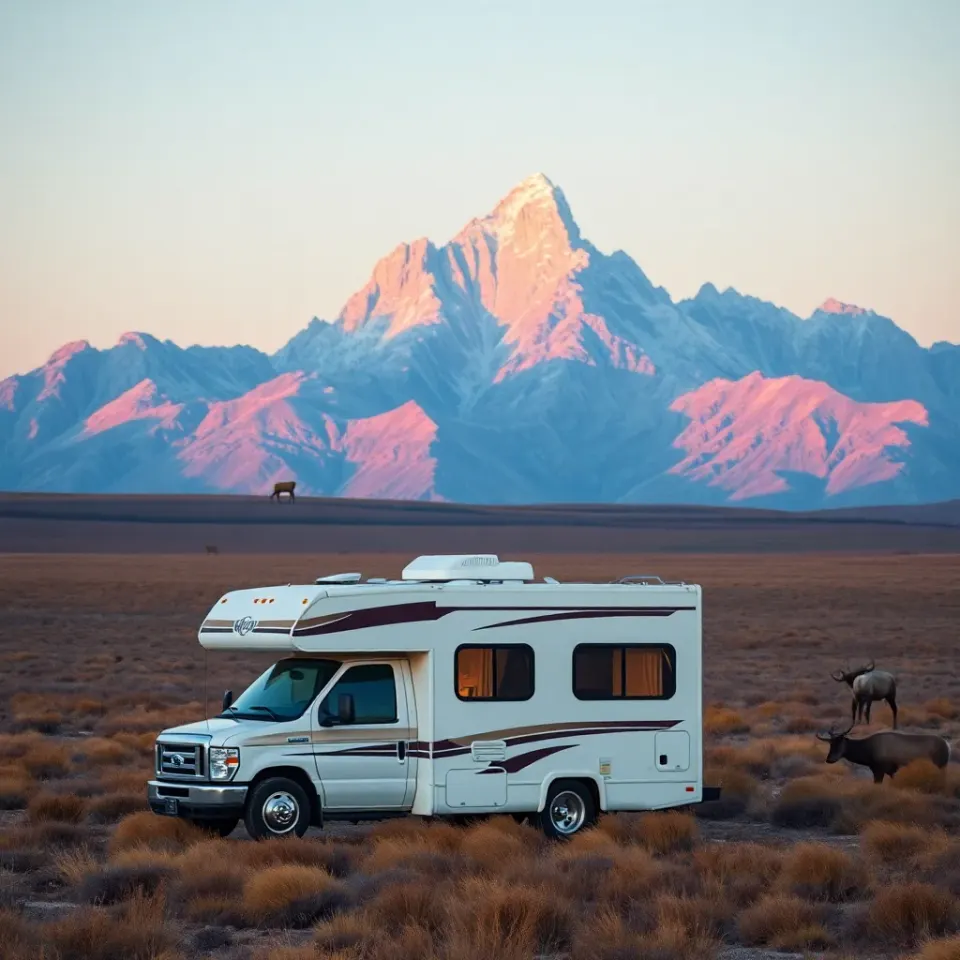
 The first morning at Gros Ventre, I woke to elk grazing the sage flats and the Teton range already lit pink above the campground — no drive, no trailhead, just unzip the door. That’s the case for doing Yellowstone and Grand Teton as one RV loop instead of two trips: the two greatest landscapes in the Northern Rockies sit shoulder to shoulder in northwest Wyoming, and ten days is exactly enough to live inside both without spending your vacation packing and unpacking. This is the route from Jackson, the natural launch, with the one logistics trap that sinks first-timers spelled out before it can sink you.
What does the trip look like at a glance?
Ten days, about 600 miles, two national parks, best run mid-June through August. The mileage is modest; the time isn’t, because Yellowstone drives slow — 45 mph limits, and a single bison herd can hold the road for half an hour.
- Launch: Jackson Hole, WY (JAC airport, most rentals within 15 minutes)
- Distance: ~600 miles round trip
- Recommended class: Class C 28-30 ft — fits every campground including Mammoth’s 30-foot cap
- All-in budget: $4,600-$5,300 for two people
- Best months: mid-June–August (full access); late September for the elk rut and thinner crowds
Day-by-day route
Day 1: Jackson pickup → Grand Teton
Pick up the rig near JAC, provision in town, and drive the 20 minutes to Gros Ventre Campground on the park’s southeast edge. Set up, then chase the light to Mormon Row for sunset on the Moulton barns — the most photographed frame in the Tetons for a reason. Camp: Gros Ventre (electric loop ~$30–$45).
Day 2: Grand Teton full day
Take the Jenny Lake shuttle boat across to Hidden Falls and Inspiration Point, then push up Cascade Canyon as far as your legs want (4 to 9 miles round trip). Close the day at Schwabacher Landing, where the range doubles in the still Snake River water. Camp: Gros Ventre.
Day 3: Grand Teton → Yellowstone (Grant Village)
A morning Snake River float or the Phelps Lake loop, then drive the Teton interior north to Yellowstone’s south entrance — 65 miles, about 90 minutes. Set up at Grant Village on Yellowstone Lake and walk West Thumb Geyser Basin at dusk, where hot springs steam right at the shoreline. Camp: Grant Village (~$35+).
Day 4: Old Faithful and the geyser basins
Time Old Faithful, then walk the Upper Geyser Basin — Castle, Grand, and Riverside are worth the loop more than the headliner. Afternoon at Black Sand and Biscuit basins, and finish at Midway for Grand Prismatic; hike the short Fairy Falls spur to the overlook for the aerial-postcard angle. Camp: Grant Village.
Day 5: Grant → Canyon
Drive the Grand Loop north with stops at Mud Volcano and Sulphur Caldron, then set up at Canyon and spend the afternoon at the Grand Canyon of the Yellowstone — Artist Point for the classic view of the Lower Falls. Camp: Canyon (~$35+).
Day 6: Canyon and Hayden Valley
The South Rim Trail to Lookout Point in the morning, the Brink of the Lower Falls switchbacks if your knees are willing, then an evening wildlife drive through Hayden Valley — bison for certain, and the patient watcher’s odds at wolves. Camp: Canyon.
Day 7: North to Lamar and Mammoth
Drive toward Tower Fall and Calcite Springs, then into the Lamar Valley — the “American Serengeti,” and the best wolf and grizzly watching in the Lower 48. End at Mammoth Hot Springs and its travertine terraces. Camp: Mammoth (~$25+; 30-foot rig limit).
Day 8: Lamar dawn patrol
Wildlife moves at dawn, so this is the early one: back into Lamar before sunrise with binoculars and a thermos. The wolf-watcher regulars with spotting scopes are your best intel — they share. Afternoon on the Lamar River Trail. Camp: Mammoth.
Day 9: Mammoth → Grand Teton (Colter Bay)
The long transit day — Mammoth back south past Norris, Madison, and West Thumb, about 175 miles. Land at Colter Bay RV Park on Jackson Lake for a well-earned full-hookup night (112 sites, 20/30/50-amp). Camp: Colter Bay RV Park (~$80).
Day 10: Last Teton morning → return
Coffee with the range, a short walk on the Lakeshore Trail, then dump tanks, refuel, and return the rig in Jackson before your JAC flight.
What does it cost all-in?
About $4,600-$5,300 for two — and Jackson’s rental market is why this trip costs more than any other in the Rockies. Our July 2026 pull of 3,398 live listings put the national median at $150/night; Jackson’s median came in at $229, and a peak-summer Class C runs $250-$280. Treat these as a research-date snapshot — rates move with the season.
| Line item | Amount |
|---|---|
| Class C rental: $260/night × 10 (peak Jackson) | $2,600 |
| Booking fees + insurance + cleaning | $650–$850 |
| Fuel (600 mi @ 7 mpg @ $3.85/gal, loaded) | $330 |
| NPS America the Beautiful pass | $80 |
| Campgrounds (NPS $25–$35 × 9 + Colter Bay $80) | $305–$345 |
| Snake River float (optional) | $80–$120 |
| Food, propane, activities (2 people) | $700–$1,100 |
| All-in, 10 days | $4,745–$5,425 |
Starting in Bozeman drops you at the quieter north gate with a bigger fleet to choose from — though our July 2026 data put Bozeman’s median ($274) above Jackson’s ($229), so don’t assume it’s the cheaper start. Our RV rental cost guide breaks down where each dollar goes.
How do you actually book the campgrounds?
This is the step that ends trips before they start: Yellowstone runs on two booking systems in 2026, and using the wrong one means no site. Here’s the current split.
- Yellowstone National Park Lodges (Xanterra): Grant Village, Canyon, Madison, Bridge Bay, and Fishing Bridge RV Park — the only in-park site with full hookups, taking combined rig-plus-tow lengths up to 95 feet.
- Recreation.gov: Mammoth plus the smaller north-side grounds — Indian Creek, Slough Creek, Tower Fall, and Lewis Lake.
- Grand Teton: everything through Recreation.gov on a six-month rolling window, except Colter Bay RV Park, which books through the Grand Teton Lodge Company. Gros Ventre runs April 27–October 9 in 2026; Colter Bay May 21–September 26.
Both systems open reservations six months ahead, and July–August dates vanish within minutes — set a calendar alarm for your arrival date minus six months. One forward note that shows why you check every year: beginning in 2027, the five Xanterra campgrounds move to Recreation.gov, so the system you used last time may not be the one you use next.
Which RV class fits both parks?
A Class C, 28-30 ft — long enough to live in, short enough for Mammoth’s 30-foot cap.
| Class | Yellowstone/Teton fit |
|---|---|
| Class B under 22 ft | Fits everywhere; tight for ten days |
| Class C 26-30 ft | The sweet spot — every campground works |
| Class C 30-32 ft | Watch Mammoth’s 30-foot limit |
| Class A 32-35 ft | Fits Fishing Bridge and Colter Bay hookups; shut out elsewhere |
| Class A 35+ ft | Skip — most NPS loops won’t take it |
What goes wrong out here — and how do you handle it?
Most of it is predictable, which means most of it is preventable.
- Sites sold out: keep private backups — Headwaters at Flagg Ranch just south of Yellowstone, or a Gardiner park north of the Mammoth gate.
- Bison jams: a herd can hold the road 30-plus minutes. Build slack into every drive time and never crowd wildlife.
- Cold nights: even July drops to 35–40°F at altitude. Pack real layers.
- Bear country: hard-sided food storage is mandatory at every campground — confirm your rental has a proper setup before you leave the lot.
Bottom line
The ten-day Yellowstone and Grand Teton loop from Jackson is the best two-park RV trip in the country. Budget $4,600-$5,300 for two, run a Class C 28-30 ft, book both parks six months out — through the right system — and plan around bison time, not clock time. See our Yellowstone and Grand Teton park guides, the Jackson and Bozeman launch-city guides, and if you’re driving in from farther out, the Denver-to-Yellowstone and Salt Lake City trip routes.
Frequently Asked Questions
How many days do you need for Yellowstone and Grand Teton together?
Ten is the comfortable number: two full days in Grand Teton and six in Yellowstone, with the drive days folded in. You can compress it to seven if you skip the Teton hikes and run Yellowstone's loop hard, but Yellowstone alone is bigger than Rhode Island — rush it and you spend the trip in the driver's seat behind a bison.
How do you reserve campgrounds in Yellowstone for 2026?
Through two different systems, which trips up most first-timers. For 2026, Grant Village, Canyon, Madison, Bridge Bay, and Fishing Bridge RV Park book through Yellowstone National Park Lodges (the Xanterra concessioner); Mammoth and the smaller north-side grounds — Indian Creek, Slough Creek, Tower Fall, Lewis Lake — book through Recreation.gov. Both open six months ahead. Beginning in 2027, the five Xanterra campgrounds move to Recreation.gov, so double-check the year you're booking.
What does a Yellowstone-Grand Teton RV trip cost?
About $4,600-$5,300 all-in for two people over ten days: roughly $2,600 for a peak-season Class C at Jackson rates, $650-$850 in fees and insurance, ~$330 fuel for 600 loaded mountain miles, an $80 park pass, around $325 in campgrounds, and $700-$1,100 for food and activities. Jackson is a premium market and the parks aren't cheap — expect this trip to run several hundred dollars more than an equivalent Utah Mighty 5 loop.
What size RV fits the campgrounds in both parks?
A Class C in the 28-30 foot range. It clears Mammoth's 30-foot limit, fits every Grand Teton loop, and stays comfortable for ten days. Fishing Bridge RV Park is the only in-park site with full hookups and takes combined rig-plus-tow lengths up to 95 feet; Colter Bay RV Park in Grand Teton has 112 full-hookup sites. Everything else is dry camping.
Is it cheaper to start in Jackson or Bozeman?
Not as clear-cut as the internet claims. The common advice is that Bozeman is the budget entry, but our July 2026 pull actually put Bozeman's median at $274/night versus $229 in Jackson — higher, not lower. What Bozeman really buys you is a bigger fleet with more availability and the quieter north gate, at the cost of a longer first-day drive to the Tetons. Fly into JAC and start in Jackson for the shorter approach and the Teton views on day one; choose Bozeman if the north-gate access and rig selection matter more than the drive.
When is the best time to go?
Mid-June through August for full road and campground access. Late September is quieter with the elk rut bugling in the Tetons and a real chance of early snow. May opens Grand Teton's Gros Ventre (April 27) before most Yellowstone interior services, so it's a Teton-first shoulder option. Yellowstone's interior roads close to regular vehicles November through April.