Florida Keys + Everglades — 7-Day RV Trip From Miami
Typical rate: $2,900-$3,700 all-in for two people, 7 days
 Take this route with you Tap to open the full route in Google Maps — save it or start turn-by-turn navigation from your phone. Open in Google Maps →
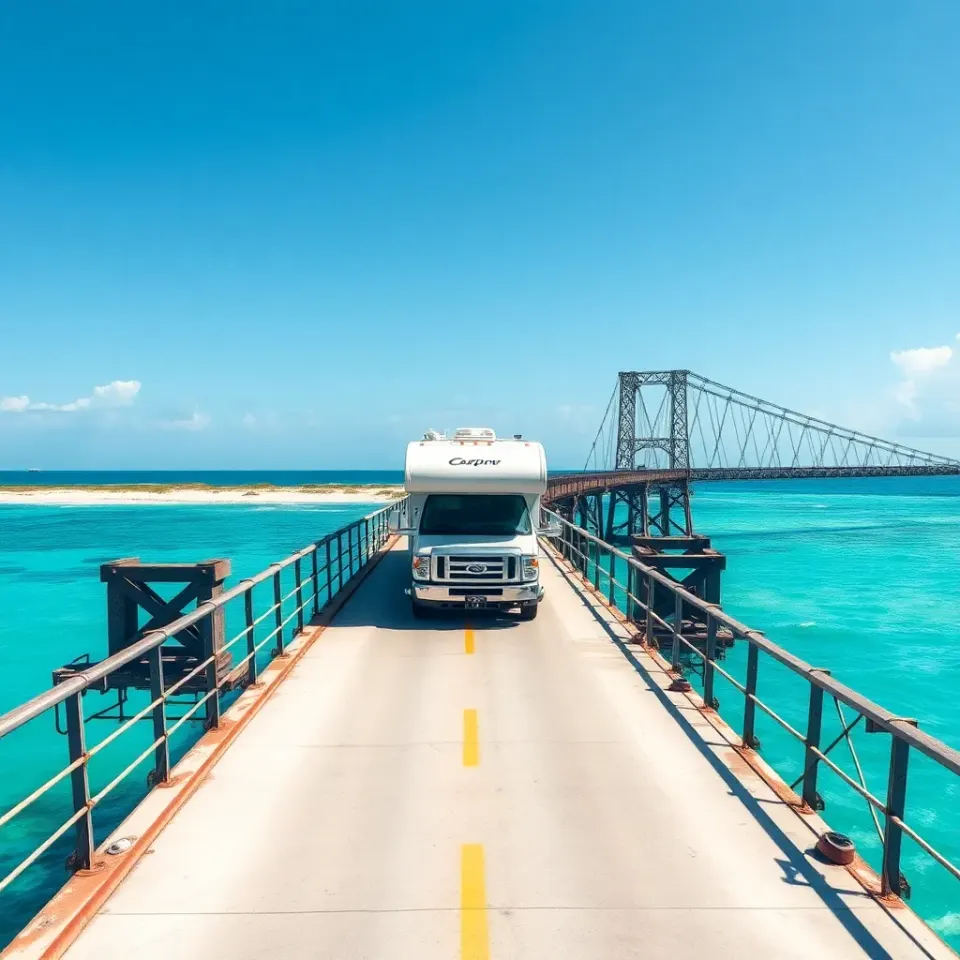
 There’s a moment on the Seven Mile Bridge — no land in sight, turquoise on both sides, the old railroad trestle running parallel like a ghost — when you understand why people rent an RV just to drive US-1 to its end. The Florida Keys and Everglades stitch together the most distinctive week in American RV travel: the country’s only living coral reef, a highway that island-hops to Key West, and a river of grass full of alligators. This is the 7-day loop from Miami — with the one booking rule that decides whether you sleep at Bahia Honda or a parking lot.
What does the trip look like at a glance?
Seven days, about 400 miles, one highway to the end of the country, best run November through April.
- Launch: Miami, FL (MIA or FLL airport)
- Distance: ~400 miles round trip
- Recommended class: Class C 25-28 ft (fits every Keys state park that takes RVs; Bahia Honda’s Sandspur loop caps at 23 ft)
- All-in budget: $2,900-$3,700 for two people
- Best months: November–April (dry season, low bugs, no hurricanes)
The one thing to book first
Florida state parks open 11 months ahead for residents and 10 for non-residents — and that gap is where out-of-state visitors lose Bahia Honda. The Keys’ best state-park sites (Bahia Honda’s Buttonwood, Bayside, and Sandspur loops; John Pennekamp; Curry Hammock) release through floridastateparks.org and are gone within minutes for winter dates. If you live out of state, count back ten months from your arrival, set an alarm for 8 a.m. Eastern, and be logged in early. Miss it, and private parks — Boyd’s on Stock Island, Sunshine Key near Bahia Honda — are the fallback at resort prices.
Day-by-day route
Day 1: Miami → Key Largo
Pick up the rig, provision in Miami (the Keys mark everything up), and drive US-1 south to Key Largo. Spend the afternoon at John Pennekamp Coral Reef State Park — the first undersea park in the country — on a glass-bottom boat or a snorkel trip over the reef. Camp: John Pennekamp (~$43) or a Key Largo private park.
Day 2: Key Largo reef day
A morning reef trip if you skipped it, then the Florida Keys Wild Bird Center and a slow Islamorada afternoon — this is the diving-and-fishing heart of the Upper Keys. Camp: Key Largo.
Day 3: Key Largo → Marathon
Drive the Middle Keys, stopping at Robbie’s to feed the giant tarpon and the Islamorada Hurricane Monument. Set up near Marathon and catch sunset at Sombrero Beach. Camp: Curry Hammock SP (~$43) or a Marathon resort.
Day 4: Marathon + the Old Seven Mile Bridge
The Turtle Hospital or Dolphin Research Center in the morning, then walk or ride out the Old Seven Mile Bridge to Pigeon Key, the little railroad-era work camp stranded in the Gulf. Camp: Marathon.
Day 5: Marathon → Bahia Honda → Key West
Stop at Bahia Honda State Park — the beach that lands on every Keys postcard — and walk the old bridge span for the view down the island chain. Then roll into Key West for the Mallory Square sunset celebration and a Duval Street evening. Camp: Boyd’s or Leo’s on Stock Island (~$90-$150).
Day 6: Key West
The Hemingway Home and its six-toed cats, the Southernmost Point photo, the lighthouse, and — if the weather cooperates — planning a Dry Tortugas ferry day (ferry-only, and worth it). Camp: Stock Island.
Day 7: Key West → Everglades → Miami
Drive back up US-1 and cut west on the Tamiami Trail to Shark Valley, where the tram loop rolls past sunning alligators, then finish the 45 minutes into Miami to return the rig. Camp: trip ends.
What does it cost all-in?
About $2,900-$3,700 for two — and in the Keys, the campsite, not the rig, is the budget driver. Our July 2026 pull of 3,398 live listings put the national rental median at $150/night; a Miami Class C runs a bit above that, but a private Lower Keys resort site can cost more per night than the motorhome. Treat these as a research-date snapshot.
| Line item | Amount |
|---|---|
| Class C rental: $185/night × 7 | $1,295 |
| Booking fees + insurance + cleaning | $400–$550 |
| Fuel (400 mi @ 8 mpg @ $3.55/gal) | $178 |
| Campgrounds (state park ~$43, private Keys $90–$150) | $475–$700 |
| Activities (reef trip, tram, Hemingway Home) | $150–$300 |
| Food, dining, propane | $500–$800 |
| All-in, 7 days | $2,998–$3,823 |
One Keys-specific line to confirm before you book: many rental companies charge a salt-spray cleanup fee of $50-$150 on return. Our RV rental cost guide covers the rest of the method.
Should you drive down or have the RV delivered?
For one base in Key Largo, delivery is cheaper than driving. For a Key West base, delivery becomes the biggest line on the trip. Almost every RV that serves the Keys is kept on the mainland, so a delivered trailer comes down US-1 and the host charges by the mile.
Our featured source for this is Florida Keys RV Rentals, a finder site that tracks which Outdoorsy listings can reach each key. It is part of the RV rental network we operate alongside BestRV. Its count on October 14, 2026:
| Key | RVs whose delivery reaches it | Median day rate | Delivery one way at the $4.00/mile median |
|---|---|---|---|
| Key Largo | 79 | $165 | $140 |
| Marathon | 71 | $175 | $352 |
| Key West | 42 | $126 | $548 |
Figures from its Keys delivery guide. Miles run from the Princeton rental lots south of Homestead, so a host based further north in Miami will quote more.
Set that against our budget above. We put $1,295 against the Class C alone, before a single campsite. The site prices a whole delivered week at $1,295.40: a median travel trailer at Pennekamp, delivery one way, the park’s fees and both taxes (its cost breakdown). Cleaning and generator fees are not in either figure.
What that means for this route:
- Staying in the Upper Keys all week: have a trailer delivered and drive your own car. You give up the loop, and the rig, site and delivery come to about what the motorhome alone costs in our table.
- Running the full loop to Key West, as this guide does: pick up in Miami and drive. Delivery to Key West is $1,096 both ways at the median, more than the whole campground line in our table, and only 42 listings reach that far.
Hosts publish a delivery range, a median of 115 miles, and Outdoorsy does not say whether that is road miles. By road, Key West is 137 miles from the Princeton lots, so a median host who counts road miles stops 22 miles short. Before you book a Lower Keys site around a Miami trailer, ask the host in the booking messages whether they deliver to that park, and whether the fee is one way or both.
Which RV class fits the Keys?
A Class C, 25-28 ft, is big enough to live in and short enough for every RV loop on the route. The state parks are looser on length than their reputation; one loop at Bahia Honda is the exception.
| Class | Florida Keys fit |
|---|---|
| Class B under 22 ft | Fits every RV site, including Bahia Honda’s Sandspur loop (23 ft cap) |
| Class C 24-32 ft | The sweet spot. Pennekamp, Curry Hammock and Bahia Honda’s Buttonwood loop all work; Sandspur does not |
| Class C 32-35 ft | Pennekamp, Curry Hammock and Buttonwood; not Sandspur |
| Class A 30-40 ft | Curry Hammock (70 ft max) and most Pennekamp sites (40 ft). Buttonwood takes large RVs but publishes no length |
| Travel trailer under 28 ft | Works well for a stationary base if you have a tow vehicle |
Limits from the Florida State Parks amenities pages for John Pennekamp, Curry Hammock and Bahia Honda, checked October 14, 2026. Bahia Honda publishes no length for Buttonwood, so call the park before you book a big rig there. Long Key has no RV camping: its campground is hike-in, tent only.
What goes wrong down here — and how do you handle it?
The Keys’ hazards are heat, timing, and a single road.
- No Bahia Honda site: fall back to Calusa in Key Largo or a Big Pine Key private park, and day-trip the beach.
- Hurricane season: June-November carries real cancellation risk — travel insurance is close to mandatory.
- Gators on the Tamiami Trail: they cross US-41 at dusk; slow down.
- One road, one speed: the Overseas Highway backs up fast — build slack into every drive time.
- Salt everywhere: confirm the cleanup fee up front and rinse the rig before return if you can.
Bottom line
The 7-day Keys and Everglades loop is the most distinctive RV week in the East — turquoise water to the end of US-1, then alligators on the way home. Go in dry season, book your state-park site the day your window opens (10 months out if you’re from away), run a Class C in the 25-28 ft range, and expect the campsites to cost more than the rig. See our Florida state guide, Miami city guide, and — if you’re bringing the dog — the pet-friendly rental guide.
Frequently Asked Questions
How far ahead do you book campgrounds in the Florida Keys?
As far ahead as the system allows, which depends on where you live. Florida state parks — Bahia Honda, John Pennekamp, Curry Hammock — open reservations 11 months out for Florida residents and 10 months for non-residents, through floridastateparks.org (ReserveAmerica). Winter dates at Bahia Honda vanish within minutes of release. Private parks like Boyd's or Sunshine Key book directly, 4-6 months ahead for peak winter.
When is the best time for a Keys and Everglades RV trip?
November through April. That dry season is the whole game: Everglades wildlife concentrates around shrinking water holes so you actually see alligators and wading birds, the mosquitoes back off, and you're clear of hurricane season. May through October brings lower rates but brutal heat, relentless bugs, and real storm-cancellation risk — carry travel insurance if you go then.
What does a Florida Keys RV trip cost?
About $2,900-$3,700 all-in for two over seven days — and the campsites, not the rig, drive it. Figure roughly $1,300 for a Class C at Miami rates, $400-$550 in fees and insurance, ~$180 fuel, $475-$700 in campgrounds (state parks ~$43, private Keys resorts $90-$150 in winter), $150-$300 in activities, and $500-$800 for food. Keys camping is genuinely expensive in peak season.
What size RV works in the Florida Keys?
A Class C, 25-28 feet. It fits all three Keys state parks that take RVs and is manageable on the Overseas Highway's bridges. The official limits are wider than the usual advice: Curry Hammock allows RVs up to 70 feet, most John Pennekamp sites take 40 feet, and Bahia Honda's Buttonwood loop takes large RVs without publishing a number. So a Class A can get a state-park site. The one trap is Bahia Honda's Sandspur loop, capped at 23 feet from hitch to bumper, so check which loop your site is in. Long Key's campground is hike-in tents only.
How long does it take to drive the Overseas Highway?
Plan 2.5 to 3 hours for the roughly 110 miles from Key Largo to Key West, not the 90 minutes the mileage suggests. US-1 runs 35-55 mph through the island towns, slows for the Seven Mile Bridge and the fishing traffic, and there's only one road — a fender-bender at mile marker 50 backs up the whole chain. Drive it relaxed.
Can you see the Everglades on the same trip?
Easily, on the way back. Shark Valley, off the Tamiami Trail (US-41) between Key West and Miami, has a 15-mile tram loop where alligators sun themselves right beside the road — the best low-effort wildlife viewing in the park. It folds neatly into the final day as you return the rig to Miami. In dry season the gators are everywhere.